





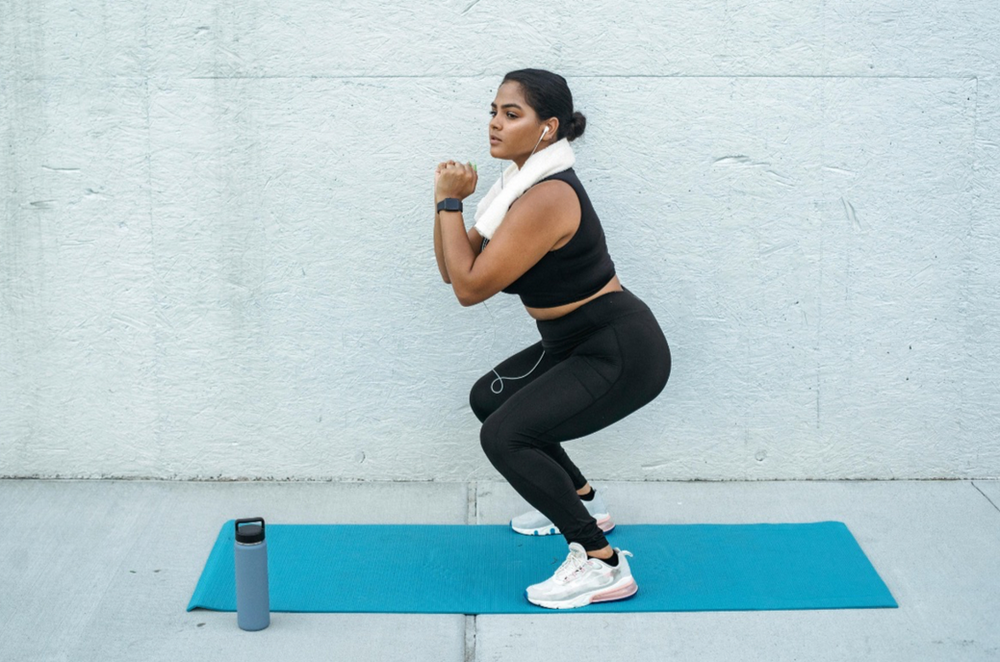
The term functional training At first it sounds a lot like competitive sport. Many people associate this with exercises with colorful ribbons, jumping exercises on boxes or unstable surfaces that are intended to promote balance. These forms of training can be part of functional training, but are not the basis.
Functional – what does that even mean?
To put it simply: Functional training is based on movement patternswhich are close to our actual movement behavior. It is essential that correct muscles for the right time within one Overall movement to use. Does it still sound a bit too “dry” in theory?
Imagine the following situation: You come home from shopping and have to transport your crates of drinks to your apartment on the third floor. When you lift, you think about everything other than the execution of your movement. It would be quite overwhelming to first mentally go through each step and think about the optimal load for your body. After the first floor, the forearms are screaming “Let go, we can’t take it anymore!” – Time to drop off. Next floor the same game. Put it down, grasp it and lift it again. When you reach the top, you put the box down because: Your child is waiting for you and wants to hug you as a greeting. You lift it up and don’t actively pay attention to your posture. For a brief moment of peace, you would like to sit in the sun on the balcony. In order to get the sun spot, you first have to move the lounger – again you have to transport something that has an unfavorable lever to carry the load, so it is even more difficult to do this without pinching your back. Finally done: you sink into your seat and enjoy the sun for half an hour, then go to your desk for the rest of the day – better not to do any more physical exertion today!
Now it is undoubtedly helpful not only to have your muscles, but also to use them in order to be able to transport the load around. However, if the movement is not functionally tailored to your musculoskeletal system, the unfavorable stress will accumulate over time. The Rest and ““No strain” as a solution to complaints does not alleviate the problem – it tends to worsen as a result. Your body can handle this for quite a while, it’s what it’s designed for. Burden and not Relief is the central element in maintaining our structures! But if you don’t prepare yourself for such everyday stresses, it can happen that one completely harmless movement a few months later acute problems comes.
This is exactly where (and ideally well before) functional training comes into play: If you prepare your structures for such everyday stress – even sitting is quite a strain – in a targeted manner, your system is fundamentally much more resilient. It doesn’t matter if the drinks crate isn’t lifted at the perfect angle. In addition, through time and conscious training, you will become one with the content you have learned Automatism make. Through this changes Your Quality of movement fundamental in everyday life, towards one healthier and more resilient Form.
Individual burdensthe more targeted Mission Your muscles, with one meaningful connection to your everyday life. In functional training you train movement patterns that have the same basis from professional sports to senior sports. This is how you set them basis for one pain-free musculoskeletal system and take care of one at the same time adequate loading of other structuressuch as Intervertebral discs, cartilage or Bone – These also benefit extremely from the right load!
Why functional movement should also be your basis
In the classic gym you often see exercises that only use one muscle group – performed on equipment, in a stable position, without great demands on balance, coordination or body tension. The problem with that? That’s not how everyday life works. Movement is always a complex interaction between muscles, fascia, tendons, bones and the nervous system. Fortunately, we don’t have to consciously control many things – that would be a cognitive imposition. Many processes are running subconsciously (including the control of balance and our position in space). However, if we don’t use them regularly or don’t challenge ourselves, the body literally breaks down. Equipment training is therefore not wrong or unnecessary – as is often the case, it depends on the individual case. In my opinion, however, it is not the basis for our everyday life, regardless of age and physical conditions.
Functional training as part of a holistic approach
Movement is usually that easiest entry into change processes – because: Our muscles are much more than just a tool for locomotion. Our muscles alone are pumping numerous messenger substances according to the load Influence on others Organs and their function. The right movement also plays a role for many people diseases of civilization a central role – for example in metabolic diseases (type 2 diabetes, lipid metabolism disorders, metabolic syndrome) (2,3,4) or rheumatic diseases (osteoarthritis, arthritis, fibromyalgia, gout) (1). You see: functional training also benefits you holistic health a.
What exactly does functional training bring you?
· You learn, Move your body more efficiently
· You understandhow movement works and how you Incorrect loads avoid
· You reduces the risk of injury – in training and in everyday life
· You develop a new one Body feelingwhich not only strengthens you in sport
· You train with purpose & mindso that you unconsciously integrate this into everyday life
It doesn’t matter whether you’re just starting out, want to start again after an injury or want to adapt your previous training. Functional training is useful for every person – provided it is individually adapted to you.
And what does that actually look like?
· Getting started with the basic movement patterns – such as squats, lunges, pulling movements, and much more
· Functional control – use the right muscle at the right time
· Stability exercises for torso, shoulder girdle, hips & legs
· Free bodyweight exercises up to the use of Dumbbells & weights
· Variations and progressionsadapted to your current performance
Conclusion: Functional training targets all areas.
Movement always works according to the same principles. It is always a consequence of Stress, regeneration and adaptation. With every small change you become a little more resilient and your system adapts to the new challenges. About that correct measurement In order to find load in functional training, it is therefore necessary regular checking Your movement patterns and yours Quality of movement. You can find out what that looks like in this article. The better your body internalizes these principles, the less attention you have to pay to them in everyday life.
You want to stay healthy in the long term, physically more resilient and you in your body feel good? Then don’t put it off until tomorrow, but take the first “functional” step forward today and start your personal training program.
The content is reduced to the most essential specialist knowledge and shortened in some places, otherwise this would exceed the content of the article. For more in-depth knowledge, I am happy to provide personal literature recommendations upon request.
1. Rausch Osthoff, A., Niedermann, K., Braun, J., et al. (2018). EULAR recommendations for physical activity in people with inflammatory arthritis and osteoarthritis. Annals of the Rheumatic Diseases, 77(9), 1251–1260.
3. American Diabetes Association. (2024). 8. Obesity and weight management for the prevention and treatment of type 2 diabetes: Standards of care in diabetes—2024. Diabetes Care, 47(Supplement_1), S113–S123. https://doi.org/10.2337/dc24-S008
4. German Obesity Society, German Diabetes Society, German Society for Nutrition, & German Society for General Medicine and Family Medicine. (2023). S3 guidelines for the prevention and treatment of obesity. AWMF registration number 050-001. https://www.awmf.org/leitlinien/detail/ll/050-001.html