





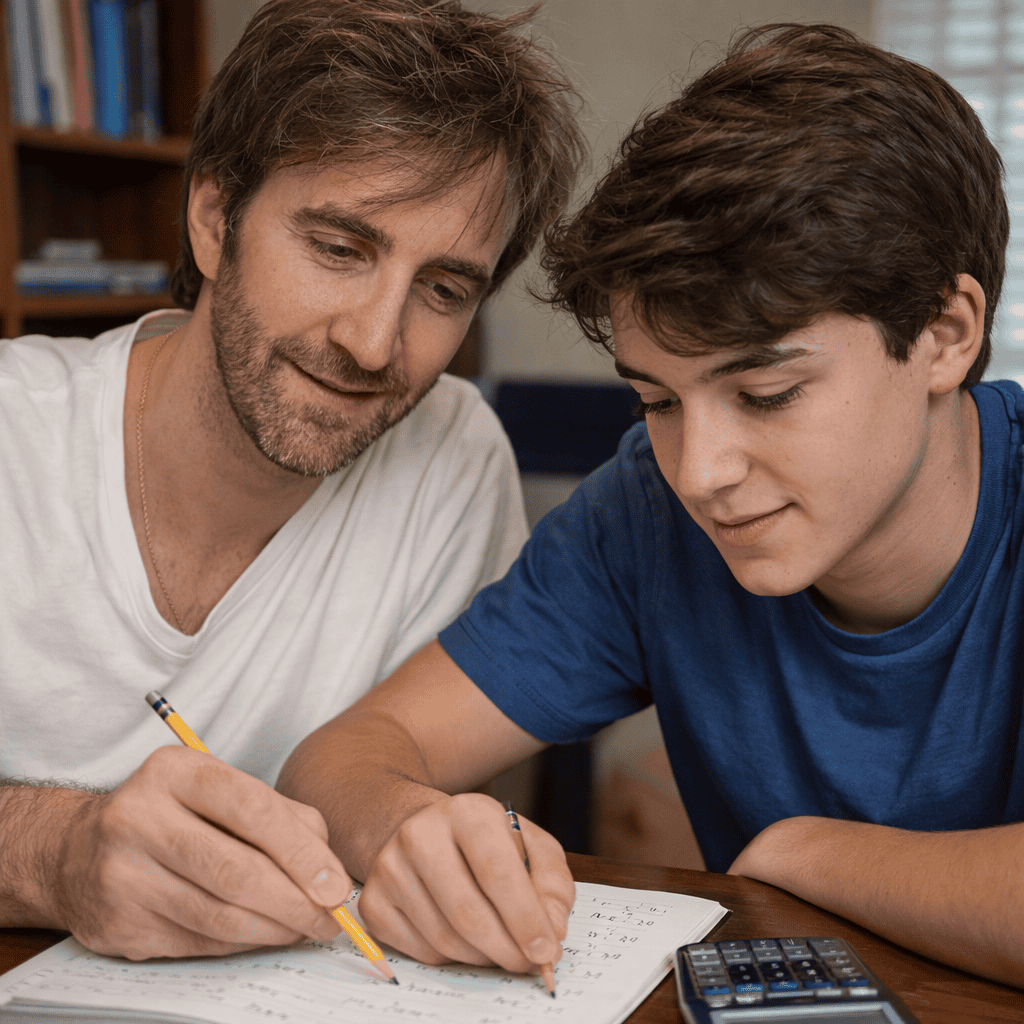
In a quarter of a century, France has lost 40 points in international PISA mathematics assessments. Among the forty countries monitored since 2000, only four have done worse. This is not an abstract statistic: it is a generation of students who arrive in higher education without the fundamentals, a generation who have learned to recite without understanding, to apply without demonstrating. And who, often, ended up believing that she was bad at math. Jérémy Marcq, doctor of mathematics, former teacher at Harvard and Boston University, thinks this diagnosis is false. The question is not the level of the students. This is the method they were taught.
From Paris VI to Harvard: the journey of a man who saw the lack of method from the inside
Jérémy Marcq is doing his undergraduate studies at theParis VI University. He then left for London, first to Queen Mary University for a research internship in general relativity, then to Imperial College London where he specializes in string theory. He completes this journey with a passage to London School of Economics to study finance and economics before crossing the Atlantic.
He obtained his doctorate in mathematics at Tufts University in Boston. It is this title that opens the doors to teaching for him. Harvard from 2012, then Boston University. For years, he taught mathematics, physics, economics and finance to students on both sides of the Atlantic. And it is there, in contact with these students, that he takes stock of the problem.
“ During my years of teaching at university, I was able to observe the way in which students approached mathematics, and noted their lack of knowledge and mastery of the fundamentals, generating a misunderstanding of the subject. he explains. Methods based on memorization have been abandoned in favor of lengthy explanations, presented as more intuitive, but often so convoluted that they end up being more complicated than what they seek to clarify.
The name of a rebel, the method of a scientist
In 1830, Évariste Galois had created his own higher algebra course because he disagreed with the teaching methods of his time. More than a century later, the Nicolas Bourbaki group had caused the emergence of a generation of renowned mathematicians by overhauling the educational approach to French math, to the point that “being French” has long remained synonymous with “being good at math”.
It is in this lineage that Jérémy Marcq founded Galois course : a mathematics workshop whose method is based on a simple principle that great teachers have never abandoned. Learn the concepts first, apply them later. Understand rather than recite. Demonstrate rather than guess.
62 weeks to cover what the school teaches in ten years
This is the number that surprises the most. In 62 weeks, at a rate of 2.5 hours per week, the Cours Galois training covers the entire mathematics program for middle school, high school, and two years of higher education. Thanks to a rigorous progression which eliminates redundancies and places each concept in its overall logic, what usually takes ten years in the classic system is done in eighteen months.
The program is structured into ten levels: algebra and set theory, geometry, general mathematics, linear algebra, analysis, probability and statistics, logic and arithmetic. Classes are held in small groups of ten students maximum, with a weekly hour of online questions and answers. Intensive courses during the holidays and study trips between Paris, London and Boston complete the training.
The training also includes learning Python and Mathematica for scientific computing, and LaTeX for writing reports and CVs. Tools that have become essential in higher education and in many professions.
A book published by Kendall Hunt, international recognition
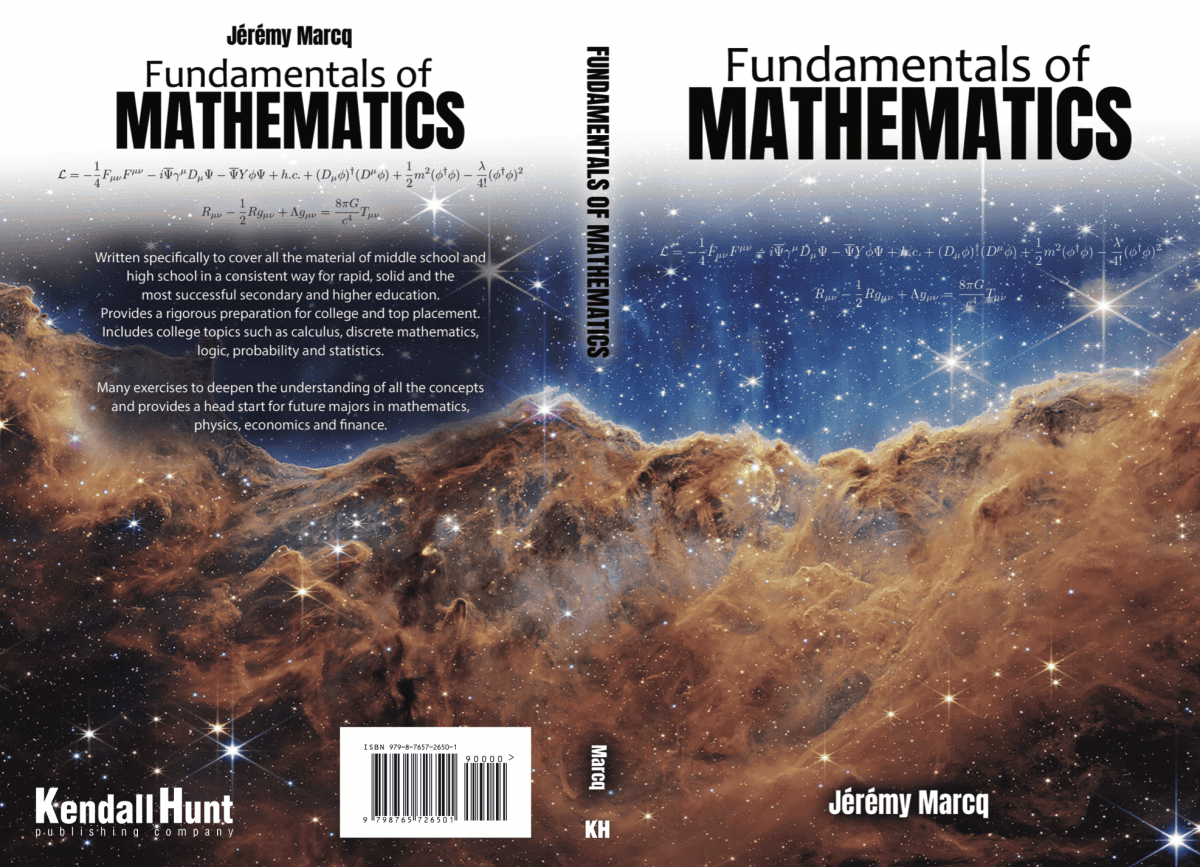
Jérémy Marcq formalized his method in a reference manual, Fundamentals of Mathematicspublished by Kendall Hunt Publishing Company. The book, designed to cover all secondary and two years of higher education mathematics, includes differential and integral calculus, discrete mathematics, logic, probability and statistics. It is used in his classes in Paris and Boston.
Who is Cours Galois for?
The short answer: everyone. The program can start at age 11 or 12 for middle school students who want to get ahead. It is also aimed at high school students in difficulty or who are preparing for a preparatory class, students who want to aim for the best universities, and adults undergoing career change who need a refresher in mathematics to prepare for an MBA or a Master’s degree.
Classes take place face-to-face in Paris or Boston, or at home. They are taught in French or English depending on the needs of the student. For private lessons at home, families can benefit from the immediate advance of the tax credit, i.e. 50% of the cost covered automatically.
At the end of the course, Jérémy Marcq personally supports his students in their applications to American, British or French universities, and to preparatory classes for the grandes écoles.
Behind the method, a conviction
What Cours Galois defends, basically, is that failure in mathematics is not inevitable. That students who arrive in the final year convinced that they are “bad at math” have simply been taught poorly. That rigor is not an obstacle to understanding, but on the contrary what makes it possible. And reconciling a student with mathematics often means giving them the tools to reconcile themselves with their own ability to reason.
In a world where mastery of mathematics determines access to an increasing number of fields, from computer science to finance and medicine, the issue goes far beyond the classroom.
Post Views: 78